


 Menu
Menu
Spanish waters hide some of the greatest mysteries on Earth. The Avilés Canyon, located about ten kilometers off the coast of northern Asturias, is an almost completely unexplored underwater world about which scientists still know very little. The reason is simple: with a depth of around 4,600 meters, this canyon is the deepest in the world. Despite all technological human ingenuity, a thorough inspection of this mysterious world is still not possible.
To give an idea of the immense depth of the steep abyss, which stretches over about 70 kilometers: the Avilés Canyon is almost three times deeper than the Grand Canyon.
Scientists now agree on the basics. Where the seabed in the rough waters of the Cantabrian Sea suddenly splits into what seems like an endless abyss, a world of abundant life exists. Up to now, 1,300 different animal species have been identified. But what exactly happens in the deepest depths remains a mystery, and animals undoubtedly live there that are still unknown to us.
It has also been established that the rocky walls of the canyon form an important protective migration route for a variety of animals, such as sperm whales, different types of sharks, dolphins, eels and lobsters. The area also attracts large numbers of fish, which find a relatively safe place for reproduction.
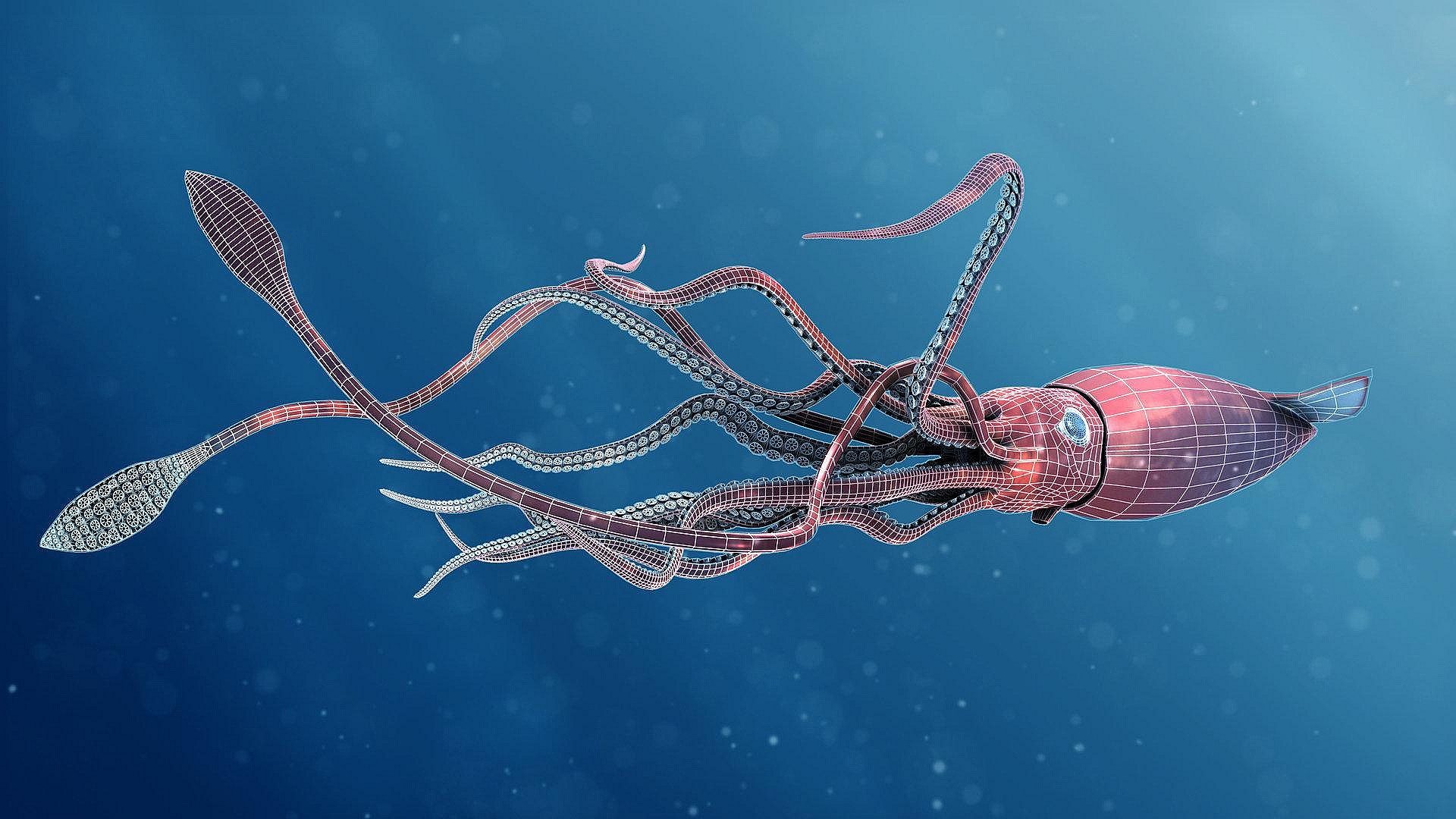
But what captures most people's imagination is the presence of giant squids. Much about the giant squid is still uncertain. A few things are known for sure: it is the largest invertebrate animal in the world. Females can grow up to 13 meters long and males up to 10 meters. They have eight arms and two longer tentacles used to capture prey. Their eyes are the largest in the animal kingdom, about 25 centimeters in diameter. They live at depths of at least 900 meters. Only in 2004 was a live giant squid seen for the first time by Japanese scientists. They very rarely wash ashore — but that has happened near the Avilés Canyon.
The giant squid fascinates also because it closely resembles a mythological creature from centuries ago: the Kraken.
Another remarkable feature of the canyon is that at about 700 meters depth, Spain's first cold-water coral reef was discovered on the rock walls. There, unusual corals, sponges and anemones grow.
PS: The illustration is an artistic impression of a giant squid.


